What Happened to Bebo? The Rise and Fall of a Social Media Giant
If you were a teenager in the UK or Ireland between 2005 and 2009, chances are you spent a significant chunk of your life on Bebo. Picking the perfect Flash Box. Obsessing over your Top 16. Sending your three daily Luvs to exactly the right people. Bebo wasn't just a website. For an entire generation, it was the internet.
So what happened to it? How did one of the most visited social networks in the world collapse so completely, and is there anywhere you can get that feeling back today?
What Was Bebo?
Bebo (short for Blog Early, Blog Often) launched in 2005, created by husband and wife Michael and Xochi Birch. Within a couple of years it had exploded in popularity, particularly in the UK, Ireland, Australia, and New Zealand, where it often overtook both MySpace and the early Facebook.
What made Bebo special wasn't just that it was a social network. It was the features. You could customise your profile with skins, choosing from thousands of ready-made designs or building your own. You had a Whiteboard, where friends could draw on your page. You could pick an Other Half, that one person who got their own special section on your profile. You shared Luv, limited to just three hearts a day, which made every single one feel meaningful. And the Flash Box: a single video or animation that sat at the heart of your profile and told the world exactly who you were.
Bebo at its peak
At its height in 2008, Bebo had over 40 million registered users and was the third most visited social networking site in the world. In the UK and Ireland it regularly outranked both MySpace and Facebook in monthly traffic.
Bebo also had blogs, quizzes, polls, photo albums, a music platform for bands, and groups. Essentially everything you'd want from a social network, wrapped up in a colourful, personalised, utterly chaotic page that felt completely yours.
The AOL Deal That Changed Everything
In March 2008, at the absolute peak of Bebo's popularity, AOL acquired the platform for $850 million. At the time it seemed like a triumph, validation that Bebo was a genuine heavyweight in the social media world.
It turned out to be the beginning of the end.
AOL, already a company struggling to adapt to the modern internet, had massively overpaid. They had no real vision for what to do with Bebo. While Facebook was growing at a staggering pace, adding features, refining the user experience, and attracting advertisers, Bebo sat largely untouched under AOL's ownership. Development stalled. The platform started to feel dated. Users began drifting away.
"We ran out of money and did a deal with AOL that we had mixed feelings about. We weren't given the resources to compete." - Michael Birch, Bebo co-founder
By 2010 it was clear Bebo was in serious trouble. AOL announced it would either sell or shut down the site. In June 2010, Bebo was sold to Criterion Capital Partners for an undisclosed sum, widely reported to be around $10 million, a fraction of what AOL had paid just two years earlier.
The Collapse
Under new ownership, Bebo attempted a relaunch but it never regained momentum. The social media landscape had shifted completely. Facebook had won. The generation that grew up on Bebo had moved on, and younger users had never known anything else.
In 2013, Bebo filed for bankruptcy. The original Bebo social network shut down. The whiteboards, the Luvs, the skins, the Flash Boxes, everything went with it. The domain was sold off. Bebo, as millions of people had known and loved it, was gone.
The full collapse in numbers
Bought by AOL for $850 million in 2008. Sold for roughly $10 million in 2010. Filed for bankruptcy in 2013. A loss of almost the entire value in under five years.
Attempts at Revival
In 2013, the original Bebo founders Michael and Xochi Birch bought the domain back for just $1 million. There were attempts to relaunch Bebo, first as a gaming platform and then as a messaging app, but none of them stuck. The Bebo people remembered and loved was never successfully rebuilt.
The story of Bebo is ultimately a story about timing, corporate mismanagement, and what happens when a beloved platform is left to wither. It didn't die because people stopped loving it. It died because the people who owned it stopped caring.
Why Do People Still Miss Bebo?
Search for Bebo today and you'll find thousands of people sharing nostalgia. "Bebo was better than anything we have now." "I'd go back to Bebo tomorrow if it came back properly." The reason isn't just sentiment. Bebo offered something modern social media has completely abandoned: personalisation.
On Bebo, your profile was yours. Your skin, your layout, your Flash Box, your whiteboard. No two profiles looked the same. Modern platforms have stripped all of that away in favour of algorithmic feeds, ads, and uniform grey boxes. People don't miss Bebo specifically. They miss what it represented: a version of social media that put the individual first.
- Profile skins that made every page unique
- Meaningful interactions like Luv (limited to three a day)
- The Other Half feature, where you publicly declared your best person
- Top Friends that actually meant something
- The Whiteboard, where friends could draw on your page
- A Flash Box that expressed your personality in one clip
- No algorithm. No ads. Just people.
Is There a Bebo Alternative Today?
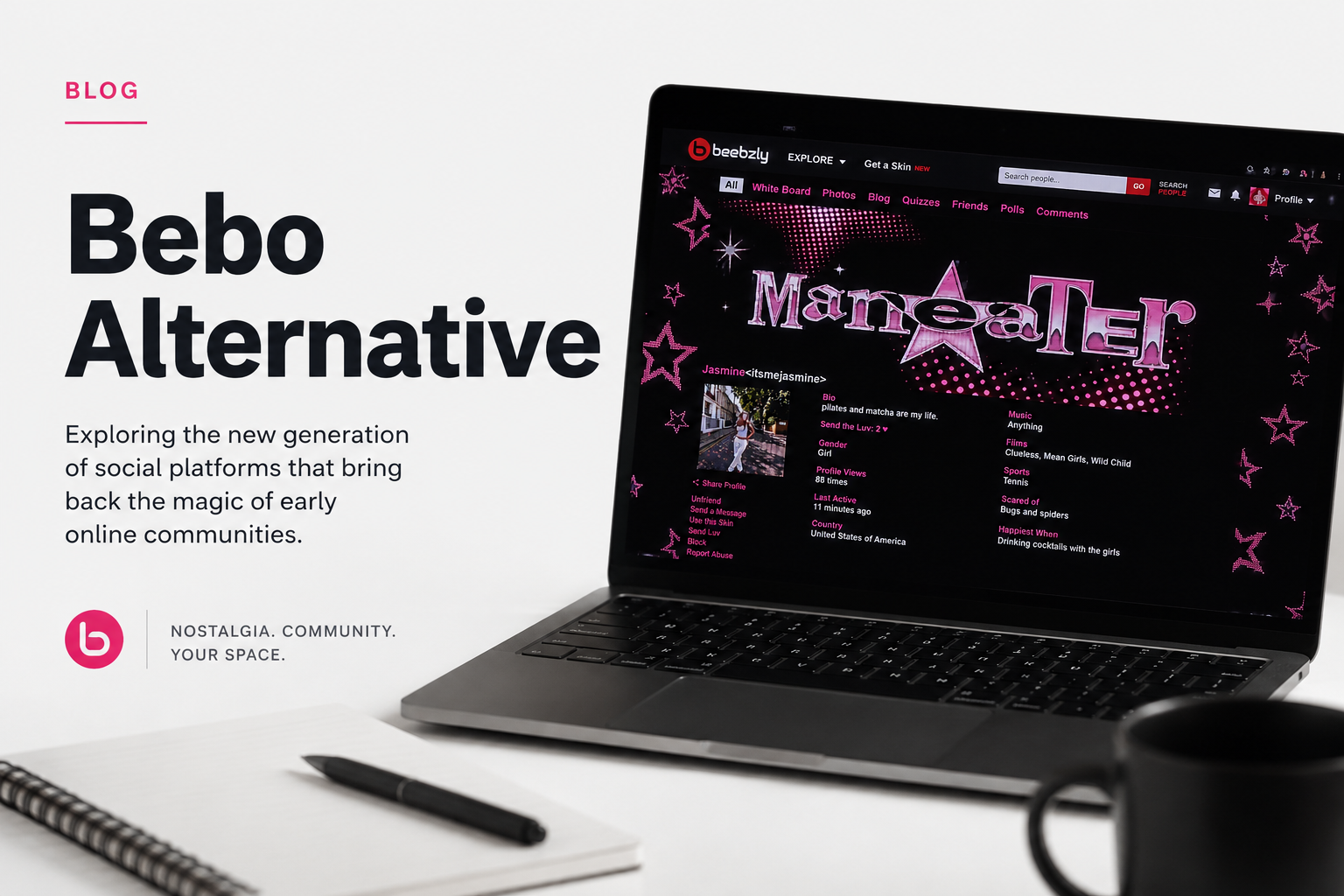
That's exactly why we built Beebzly. Beebzly is a retro social network built to bring back everything that made early 2000s social media great. Profile skins. Whiteboards. Blogs. Quizzes. Polls. Top Friends. Other Half. The Luv system. A real community of people who grew up on Bebo and want something that feels like home on the internet again.
Beebzly is completely free to join and is not affiliated with Bebo in any way. It's just built by people who loved what Bebo was and thought it deserved to exist again.
If you've been Googling "sites like Bebo" or "is there a new Bebo", you've found it.